
Close

God of Music
2026-10-20
Writing with AI and creating games with AI are no longer just laboratory experiments. There are no precise statistics on how many people are using them. However, one thing can be stated with certainty: we are using them much more than we imagine.
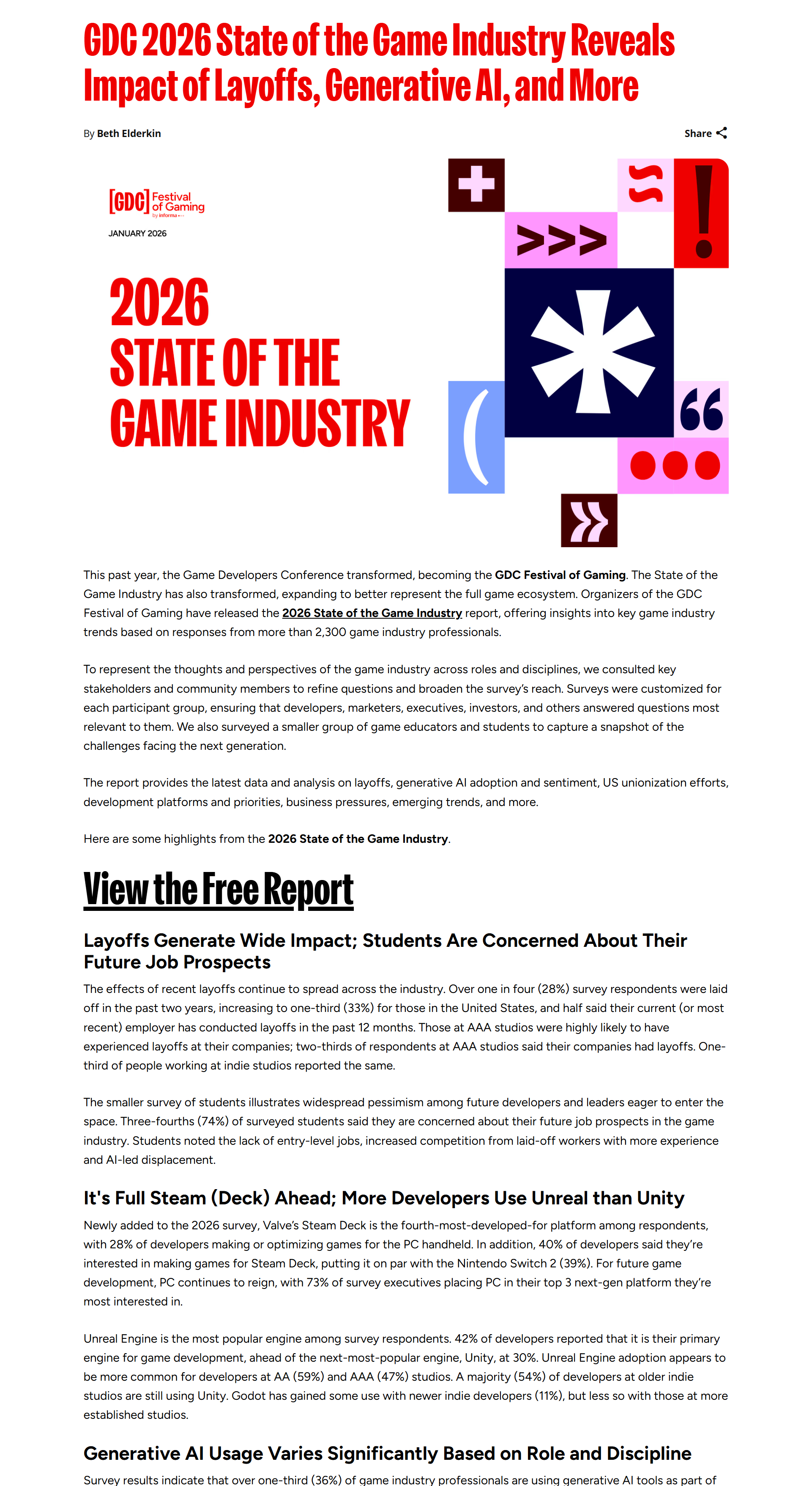
Several figures support this conjecture. A GDC survey of approximately 2,300 game industry professionals in early 2026 found that 36% directly used generative AI in their work, and 52% reported that their company used it. On Steam, the number of games disclosing generative AI use increased from about 1,000 in 2024 to approximately 8,000 in the first half of 2025 alone. According to one analysis, the proportion of new releases in 2026 that disclose AI use exceeds 30%.
Novels are no different. When BookBub surveyed about 1,200 authors, 45% reported already using generative AI in their work. In Korea, the Korea Creative Content Agency's 2025 Webtoon Industry Survey showed that 48% of webtoon companies had experience using generative AI.
What is important is that these figures are all 'self-disclosed'. Steam's disclosure relies on developers' voluntary reporting, and in the BookBub survey, about 80% of authors using AI said they do not disclose that fact to readers. Domestic web novel platforms also prohibit AI use in contests, but there is no review system yet to detect it. If this much is revealed, the undisclosed portion must be even larger.
[Figure 1. 36% of game industry professionals surveyed at GDC 2026 reported using generative AI in their work, while 45% of authors and 80% of users reported not disclosing it. https://gdconf.com/article/gdc-2026-state-of-the-game-industry-reveals-impact-of-layoffs-generative-ai-and-more/]
There is undoubtedly resistance to AI-generated creations. However, this resistance should not be lumped together. The resistance felt by readers (users) and the resistance felt by authors or developers who do not use AI have different roots.
Reading a story means entrusting one's emotions to someone. We willingly open our hearts because we believe there is a 'person' on the other side of all those emotions—laughter, tears, anger, excitement. But when readers discover that it was not a person but a probabilistic calculation on the other side, they feel their emotions have been manipulated.
A YouGov survey of 1,000 Americans found that 61% would feel less satisfied if they knew a book they read was written by AI. In the domestic web novel scene, works that revealed AI's distinctive writing style or inadvertently left behind prompt traces faced "star rating terrorism" and were subsequently discontinued. The core emotion expressed by readers was a sense of betrayal at having paid for a combination of data, not for creation.
The creator's resistance is different in nature. It is not a matter of emotion but of survival. The more AI writes, the less work I have, and the less work I have, the less income I earn.
In the GDC survey, the percentage of respondents who said generative AI was harmful to the game industry surged from 18% in 2024 to 30% in 2025, reaching 52% in 2026. Only 7% responded positively. A study by the University of Cambridge in the UK found that nearly half of novelists worried that AI could completely replace their work, and many authors indeed reported reduced income due to AI. A survey by Gotham Ghostwriters revealed that all novelists who do not use AI felt it was unfair for their work to be used for AI training.
Thus, readers seek to protect the 'authenticity of emotion,' while creators seek to protect the 'value of labor.' Although they appear to be similar forms of opposition, the solutions must differ because what they seek to protect is different.
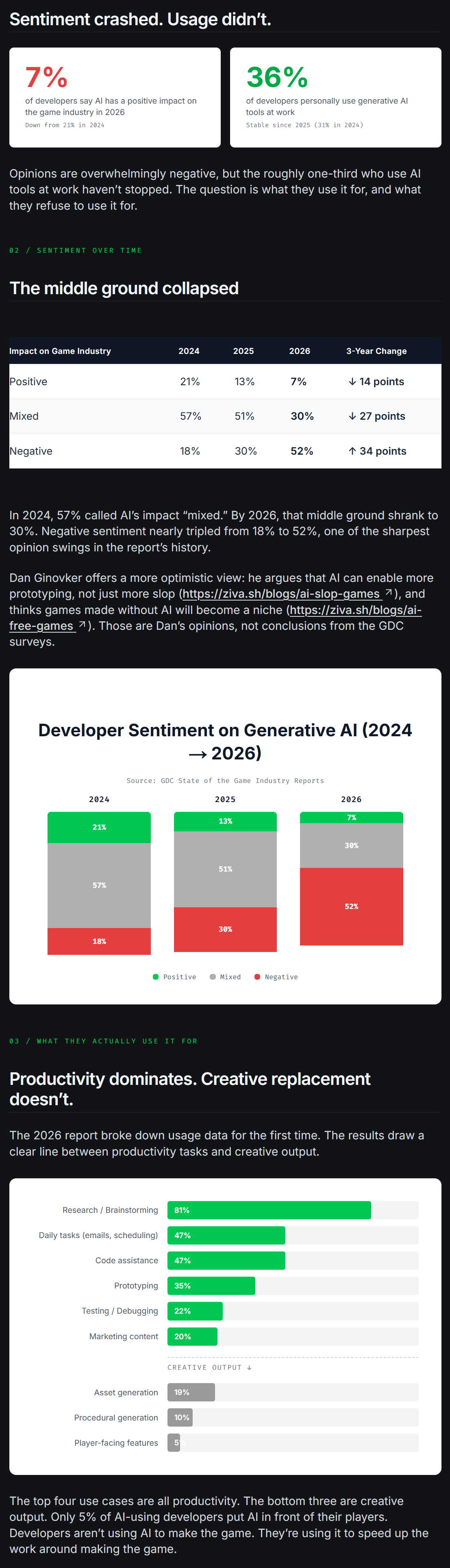
[Figure 2. ZIVA's 3-year analysis page - https://ziva.sh/blogs/gdc-2026-generative-ai-game-development-data]
To be honest, I also turn off songs, movies, and comics made with AI. I dislike them because they feel awkward. Subtle tremors in voices, misaligned expressions, and strange blurring of lines immediately catch my senses. The unpleasant sensation of encountering something almost human but subtly different, the so-called 'uncanny valley,' immediately kicks in through my ears and eyes.
However, novels and games are different. Novels are conveyed not through sensation but through meaning. The moment a sentence is read, it is re-imagined in the reader's mind. In writing, 'awkwardness' does not manifest as immediately as in sound or images. Industry insiders in Korea also say that while AI use in webtoons can be somewhat detected by the art style, it is almost impossible to discern in web novels because they are text.
Of course, if I detect awkwardness in a novel, I will close the book. Repetitive expressions, sentences that are only smooth without context, scenes where characters' emotions are merely explained. If these things catch my eye, immersion is broken.
But what if I don't detect it? Then I will enjoy reading it to the end. If it's a game, I will enjoy playing it until the ending. In fact, in an experiment conducted by Stanford researchers with novelists, readers showed no significant preference difference between human-written text and AI-assisted text.
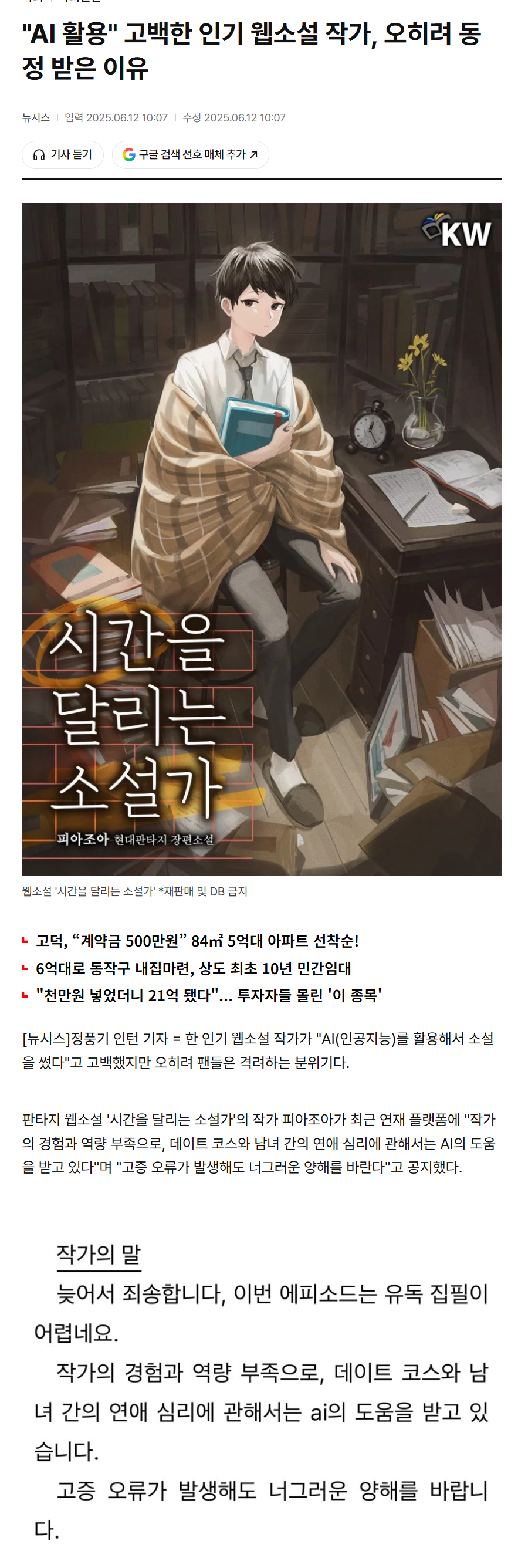
[Figure 3. Financial News (Newsis) "Why a Popular Web Novel Author Who Confessed 'AI Use' Received Sympathy Instead"https://www.fnnews.com/news/202506121007394905]
Let's narrow the discussion to novels. The ways AI can intervene in novel creation can be broadly divided into four categories.
AI creates the story and writes the text.
I create the story, and AI writes the text.
I write the text, and AI reviews the sentences.
AI and I collaborate to create the text.
These four categories are distinguished by two criteria: one is 'who owns the story,' and the other is 'who owns the sentences.'
Number 1: Both the story and the sentences belong to AI. The human merely presses a button and chooses the result. It is difficult to use the word 'author' here. This is the area where both reader's resistance and creator's concerns are most legitimately established.
Number 2: The story belongs to the human, but the sentences belong to AI. This might seem like an unfamiliar structure, but it actually has a long history. Alexandre Dumas produced vast works with his assistants, and today's webtoon studios divide planning and drawing. However, in novels, sentences are the author's voice. If the sentences are entirely handed over, it is a minimum courtesy to disclose to the reader who the owner of that voice is.
Number 3: Both the story and the sentences belong to the human, and AI acts as a proofreader. This is similar to AI replacing the work done by spell checkers and editors. In the Gotham Ghostwriters survey, the most common uses of AI by novelists were for idea generation, research, and finding appropriate words, with only 11% using it for generating main text. The game industry is similar: 81% of developers using AI use it for research and brainstorming, while only 5% use it for content directly seen by players. The majority of creators want an AI assistant, not an AI ghostwriter.
Number 4: This is the broadest and most ambiguous. Depending on the degree of collaboration, it could be closer to Number 3 or Number 2. Ultimately, the key is who makes the final decisions. If a person decides which scenes to include or exclude, what choices characters make, and whether a sentence is truly their voice, then the story's owner is still human.
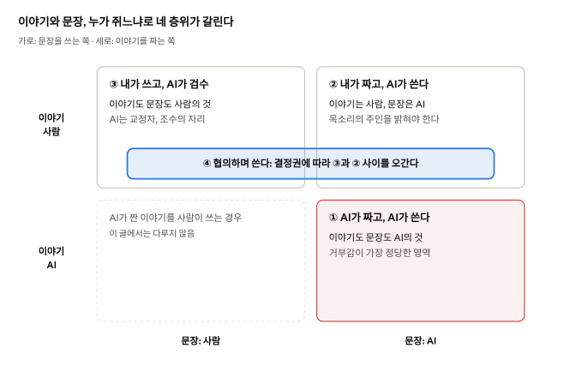
[Figure 4. The four levels are divided by who holds the story and the sentences. Horizontal: who writes the sentences, Vertical: who creates the story]
If the line differs for each person, then there is one thing we must collectively uphold: the ability to judge, which is honesty.
Readers have the right to choose according to their taste. That right can only be exercised when information is available. Steam already requires developers to indicate AI usage, and as seen in the case of the web novel author mentioned earlier, self-disclosed usage can even build trust. Conversely, usage that is hidden and then discovered, no matter how small the assistance, is perceived as a betrayal.
For creators, honesty is also a weapon. Authors who do not use AI can highlight that fact as a value, and authors who do use AI can prove their contribution by disclosing how much they used it. In a market where everyone uses AI secretly, only honest people are at a disadvantage. In a market where everyone discloses, individual choices are respected.
Will we continue to reject AI, or will we embrace it? If we embrace it, to what extent?
There is no right answer to this question. Closing a book because it feels awkward, closing it after knowing, or reading it to the end even while knowing—these are all individual choices. However, these choices cannot be made by others. Not by platforms, not by the industry, and certainly not by AI itself.
AI can create sentences. It can weave stories. But AI cannot decide whether 'this story should be accepted as human.' That remains the task of us, the people who live in the age of AI, who write stories and read stories.
Enjoyed this post? Share it


